
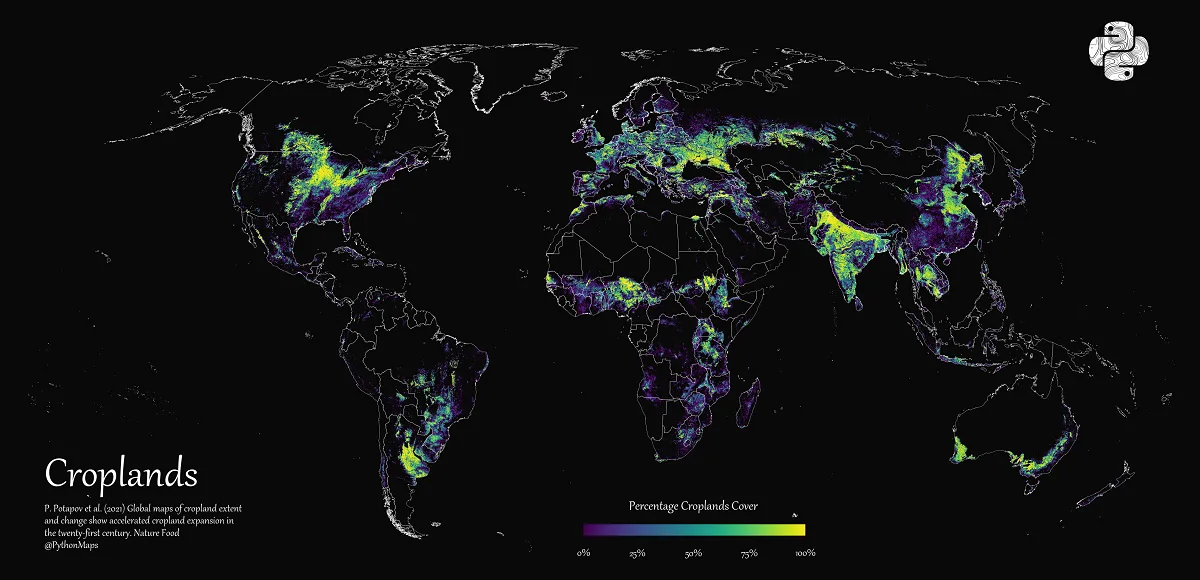
Over the past five decades, rapid global population growth has driven a significant increase in food production, leading to the expansion of croplands worldwide. According to 2019 data based on the scientific study by Potapov et al. (Nature, 2021), croplands—defined as land used to cultivate herbaceous crops for food, forage, or biofuel—covered 1,244 million hectares (Mha). This represents a 9% increase compared to the early 2000s, along with a 25% rise in net primary crop production.
Cropland distribution varies widely across regions. Europe and North Asia, as well as Southwest Asia, each account for roughly 20% of global cropland. Africa holds 17%, and South America 9%. Despite their smaller shares, Africa and South America experienced the most dramatic growth between 2000 and 2019. Africa expanded its cropland area by 53.2 Mha, while South America added 37.1 Mha, driven by technological improvements and the rise of globally demanded crops such as soybeans—particularly in Argentina, Brazil, and Uruguay. In contrast, Southeast Asia was the only region to show a net decline, as croplands were converted into plantations, orchards, and aquaculture zones.
Much of the new cropland replaced forests, grasslands, and other natural ecosystems, especially in Africa, South America, and parts of Asia. This conversion has contributed to biodiversity loss, habitat fragmentation, and increased greenhouse gas emissions. Despite these challenges, several countries are adopting more sustainable agricultural practices aimed at increasing productivity without expanding land use. As global food demand continues to rise, innovation and climate-driven changes may shape future strategies to balance agricultural growth with environmental conservation.